
Projects and structured scope
Work is divided into groups and items with quantities, units, deadlines and location.
The scope remains the reference point for the request and offers.
The BuildIt platform
BuildIt connects scope, access, documents, offers and decisions around specific work. The publishing company controls the process; admitted subcontractors and suppliers respond against the same structure.
What BuildIt organizes
The capabilities are not separate showcases. They follow the same request and pass structured information into the next decision.
Work is divided into groups and items with quantities, units, deadlines and location.
The scope remains the reference point for the request and offers.
The client chooses whether an opportunity reaches the market or only invited companies.
The offer structure remains shared in both models.
Documents and requirement responses stay connected to the relevant request and offer.
Participants work from the current context available to them.
Participants submit item prices, timing, terms, notes, responses and attachments.
Each company sees its own proposal, not competing offers.
The client compares proposals against the shared scope and can see missing information.
BuildIt organizes the data; the client makes the decision.
Profiles, available feedback, statuses and revisions support later reference.
A digital profile does not replace professional due diligence.
In the current product
These screens come from the current BuildIt interface. The data is illustrative and demonstrates the product, not real customers or outcomes.
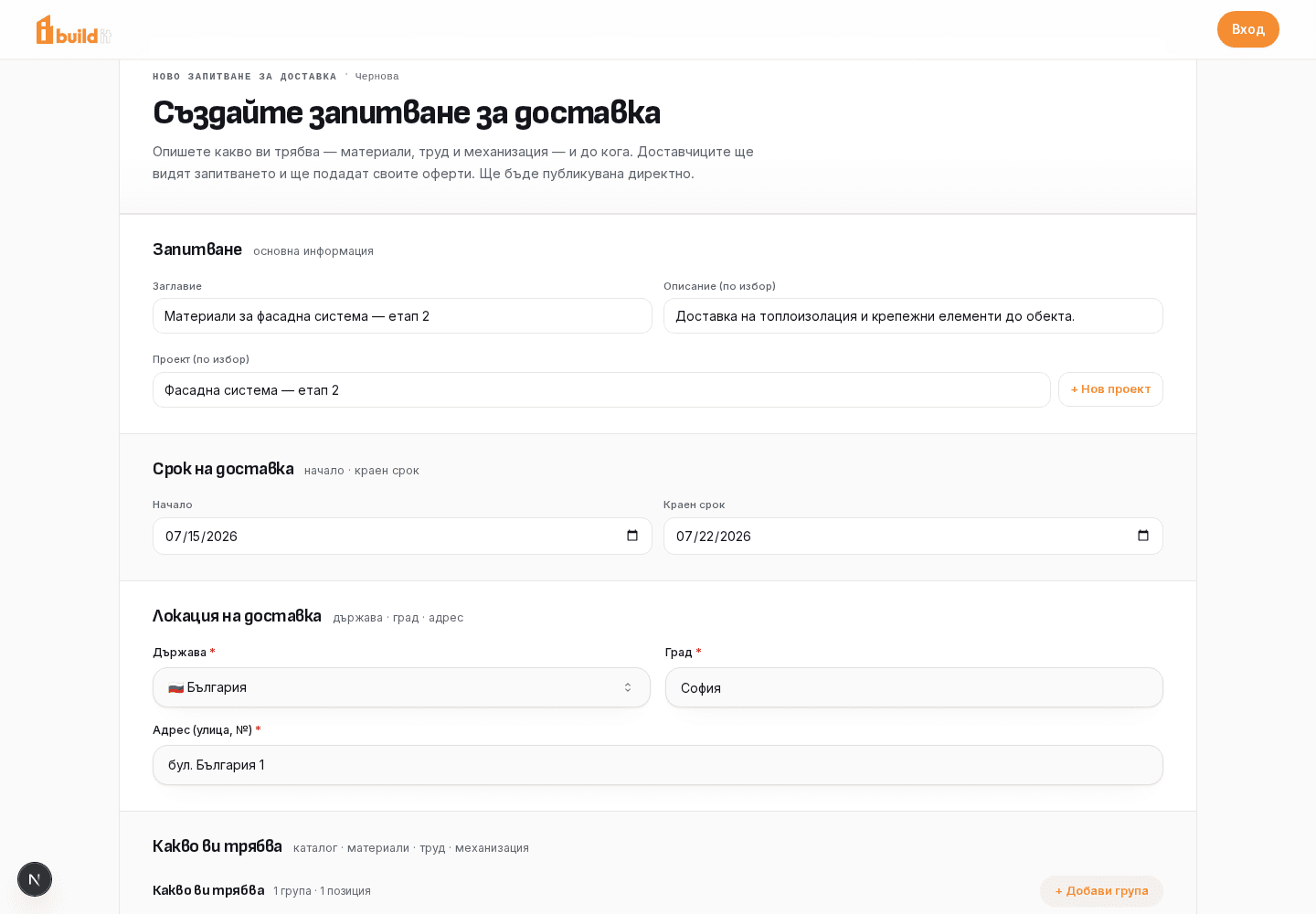
Core information, timing, location and grouped items are prepared as one request another company can use to assess participation.
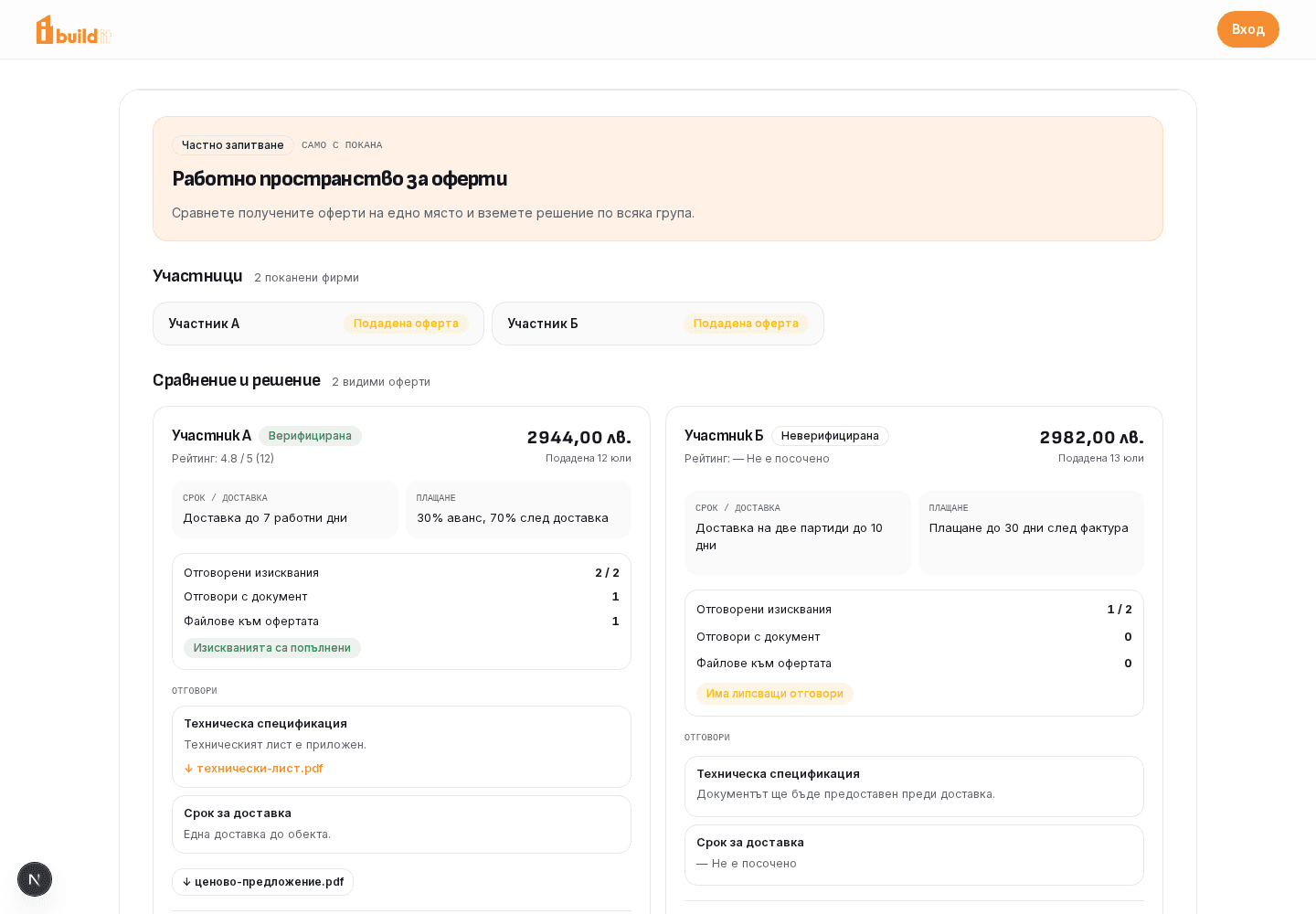
In an invitation-only process, the client sees participants and submitted proposals in the same workspace.
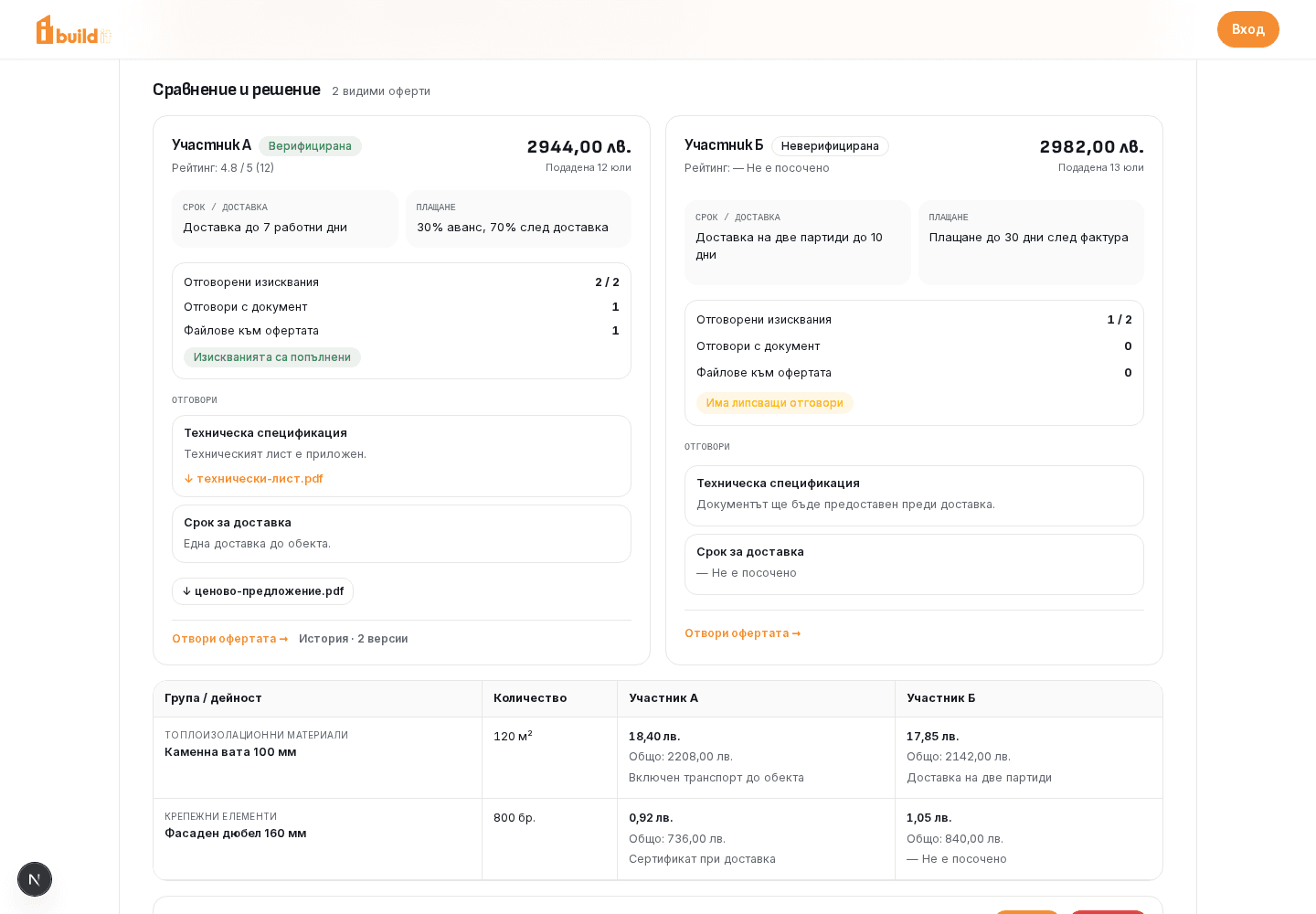
Total value, timing, payment, requirements and item prices are reviewed together before the client decides.
The process
The publishing company defines scope, access and the decision. The subcontractor or supplier assesses the opportunity and remains responsible for its own proposal.
The work or supply is described through specific items, quantities and terms.
Publishing team
Collects scope, timing, location, requirements and relevant files.
Participant
Receives the basis later used to assess capacity, price and timing.
What moves forward
One reference version of the scope.
The opportunity is public or limited to invited companies.
Publishing team
Chooses the model and identifies participants for a private process.
Participant
Finds a suitable public request or receives access through an invitation.
What moves forward
A clear boundary around who may participate.
Admitted participants see the available items, files and deadlines.
Publishing team
Maintains enough clarity for a professional proposal to be prepared.
Participant
Assesses whether it can respond and what clarification is needed.
What moves forward
A common basis for preparing proposals.
Prices, terms, responses and attachments are submitted to the same request.
Publishing team
Receives proposals that can be reviewed against shared criteria.
Participant
Prices the items and adds its actual timing, terms and documents.
What moves forward
Structured proposals with visible differences.
Comparison supports the choice but does not select a partner automatically.
Publishing team
Assesses price, completeness, terms, company context and internal criteria.
Participant
Remains responsible for accurately representing its ability to deliver.
What moves forward
A selected proposal for the specific work.
The request, statuses, available revisions and decisions remain for reference.
Publishing team
Returns to the agreed context according to its access rights.
Participant
Continues against the selected scope and retains its own history.
What moves forward
A traceable link between need, proposals and decision.
Access and trust
Visibility depends on the request type, company role and participation. BuildIt organizes information but does not replace qualification, technical, legal or contractual due diligence.
Useful when the client wants to discover capacity beyond its current network.
Useful when procurement should remain between preselected companies.
A profile, rating or verification marker is an additional signal, not a performance guarantee. The parties remain responsible for references, qualifications, insurance, technical assessment, contracts and risk control.
Short answers
No. The platform organizes scope and received information. Assessment and the final choice remain with the client.
No. The comparison workspace belongs to the client organization. Each participant works with its own offer.
Yes. A private request is accessible to invited organizations. A public request is a separate choice for reaching the market.
No. A profile and available history add context but do not replace references, qualifications, contracts or technical and legal checks.
The next step
Register your company to begin with the real workflow. If you want to see the sequence first, use the interactive simulation.